The Art of Layering Lighting in Your Living Room
The living room is the most versatile room in the house — it is where the family gathers on a quiet Sunday morning, where guests are entertained on a Saturday evening, and where someone retreats with a book at the end of the day. Those three scenarios require three entirely different lighting conditions, and a single overhead fixture cannot provide all of them.
Layered lighting is the design principle that makes a living room feel alive and adaptable. It is also one of the most frequently overlooked aspects of interior design, because it requires planning before the walls are closed and the finish work begins. At BK Interior Design, lighting is treated as a structural decision — not a decoration — and it begins at the start of every project, not at the end.
The Three Layers of Residential Lighting
Every well-lit room is built from three types of light working together: ambient light, which provides the general illumination level of the room; task light, which focuses light where specific activities take place; and accent light, which highlights architectural features, art, or objects and adds depth and visual interest. In a living room, these three layers might include recessed or ceiling fixtures, a reading lamp beside a chair, and picture lights or directional fixtures aimed at built-ins or a fireplace surround.
The key insight is that these layers should be independently controllable. A living room with all its lighting on one circuit — or worse, one switch — can only be either fully lit or fully dark. A living room with separate circuits for each layer, all on dimmers, can be an entirely different space depending on the time of day and the activity underway. That flexibility is what makes a room feel considered rather than functional.
Ambient Light: Setting the Foundation
The ambient layer provides the baseline illumination that lets people see and move safely through the room. In a living room, this is most often provided by recessed lighting, a central ceiling fixture, or a combination of the two. The common mistake is treating the ambient layer as the only layer — using enough recessed lighting to achieve grocery-store brightness, then wondering why the finished room feels institutional rather than warm.
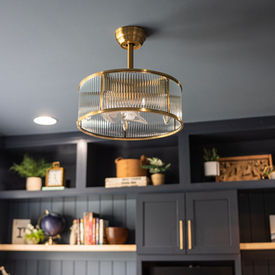
Recessed lighting is most useful in a living room when it is used sparingly and directed intentionally: aimed at art, at bookcases, or at the seating arrangement rather than blasting the ceiling with even, flat light. A single well-scaled chandelier or flush-mount at the center of the room, on a dimmer, provides ambient light with far more warmth and presence than a grid of recessed cans at full brightness.
Color temperature is the other critical variable in the ambient layer. Bulbs in the 2700–3000K range produce warm, incandescent-like light that flatters skin tones and makes materials like wood, linen, and stone look their best. Bulbs at 4000K or higher produce a cool, blue-white light that is appropriate for kitchens and task environments but is rarely flattering in a living room where warmth and ease are the goal.
Task Light: Where You Actually Need It
Task lighting in a living room is most often found at reading chairs and sofas, where a floor lamp or table lamp provides focused, directed light for reading or needlework without requiring the whole room to be lit brightly. A well-placed floor lamp beside a chair is one of the most functional and visually pleasing lighting decisions in residential design — it is also one of the most frequently omitted when owners are shopping for furniture and forget that lighting needs a place to live.
The height and direction of task light matters. A lamp shade that is opaque at the sides and open at the bottom directs light downward onto a book or work surface; a translucent shade diffuses light in all directions and provides more ambient contribution. For reading, a shade that directs light downward without glare — the bottom of the shade at roughly eye level when seated — is the most functional choice. For atmosphere, a lamp with a shade that glows softly on all sides contributes warmth to the room as a whole.
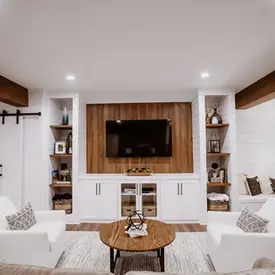
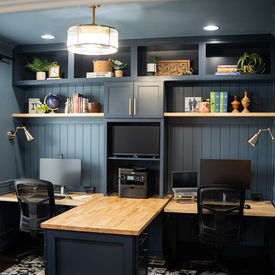
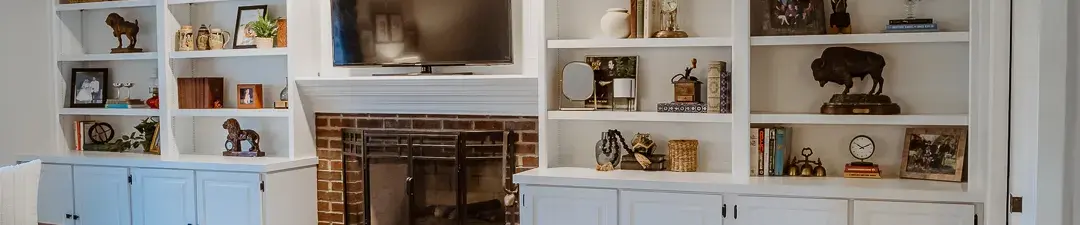
In living rooms with built-in shelving or a media wall, integrated lighting within the shelves — small puck lights, LED strips, or picture lights — serves both as task lighting for the objects displayed and as a secondary ambient source that keeps the room from feeling dark and hollow at the perimeter when the central fixtures are dimmed.
Accent Light: Depth, Drama, and Character
Accent lighting is the layer that makes a living room look designed. It is also the layer most often left out of budget renovations and new constructions, because it is easy to treat as a luxury rather than a necessity. In reality, it is what gives a room its visual hierarchy — telling the eye where to go, what to linger on, and what to skip past.
In a living room, accent lighting most commonly highlights artwork, a fireplace surround, architectural details like coffered ceilings or ceiling beams, or a collected arrangement of objects on a console or bookcase. Directional recessed fixtures or adjustable track heads can be aimed precisely at the thing you want to highlight. Picture lights mounted directly to frames provide intimate, museum-quality focus on individual pieces. A pair of wall sconces flanking a fireplace adds symmetry and draws attention to the mantel as an anchor of the room.
The most important rule in accent lighting is that the light source itself should be hidden or subtle, and the illuminated subject should be the star. A bare bulb or an overly bright fixture defeats the purpose — the eye is drawn to the glare of the source, not the beauty of what it is illuminating. Shields, baffles, low-wattage fixtures, and careful aiming angle are all tools that keep the accent layer doing its job quietly and effectively.
Planning Lighting Before the Walls Close
The single most important thing to know about layered lighting is that it must be planned before construction, not after. Recessed fixtures, switched outlets for floor lamps, dimmer circuits, and in-wall cable management for sconces all require electrical rough-in that cannot be added once drywall is up without significant disruption and cost. A lighting plan drawn at the beginning of a renovation or new construction project — ideally by an interior designer working alongside an electrician — ensures that every circuit and every switch position is in the right place for the furniture arrangement and the lifestyle the room is designed to serve.
For existing rooms where wiring changes are not practical, the portable layer — floor lamps, table lamps, and plug-in sconces — can achieve much of the warmth and variety of a fully wired layered system. Smart plugs on timers and dimmers can even allow these portable fixtures to be controlled together as a single scene. It is not the same as a purpose-designed system, but it is far better than relying on a single overhead fixture and wondering why the room never feels quite right after dark.